Atonement: Sea Change Needed!

In writing and teaching I have passionately critiqued the idea that to be able to forgive us, God had to punish Jesus in order to assuage his wrath and satisfy justice. Therefore, you might imagine that I refrain from singing many songs and hymns based on that logic. There are lines I do not sing—like “the wrath of God was satisfied” in the song, “In Christ Alone”—but often I can reframe the words and sing even if the songwriter likely had penal satisfaction in mind.

 One Sunday last spring I saw these words on the screen, “the sin of man and wrath of God has been on Jesus laid.” No way to nuance that into acceptability. I stopped singing. I glanced down at the credits. The song was written in 2012 (“Man of Sorrows”). This is not an old song. These lines were written years after my books, and others, on the atonement came out. The books have not prompted as much change as I hoped. Seeing the people around me absorbing what the line portrays about God flooded me with sadness and frustration.

 Then, a couple songs later, I saw this line: “He lived and died to buy my pardon.” Again, no way to nuance that—I couldn’t think that Jesus bought our pardon from the Devil or death. I sadly marveled. How does one can square the notion of God demanding payment for pardon with the biblical statement, and examples, that God is merciful and pardons beyond human comprehension (Is 55:7&8)? How does one square it even with common everyday understanding--forgiveness and pardon are given not bought. Again, imagining the image of God this pardon-buying concept plants in people’s minds, I left church with the conviction that I must do more to promote change. Too many people, including these song writers, accept as a given that the cross was about appeasement of God.

 At the micro level I took the step of talking to the pastor and worship leader. The conversations went well. But, what about myriads of churches around the globe? I decided I would ask for your help via this blog and I have increased my prayers for change.

 A Brief Excursus for Some Readers

If you have not read or heard my thoughts on the cross you may be wondering: “Doesn’t he think salvation comes through the cross? Does he reject substitutionary atonement?” I could just state, “I affirm substitutionary atonement; I critique one form of it—penal substitution atonement (PSA).” But since PSA is defined in different ways, here is a brief overview of what I affirm and critique.

 I affirm that the substitutionary death of Jesus on the cross provides salvation. I affirm that God worked through Jesus’ life, death and resurrection to reconcile the world to Himself, forgiving, freeing from guilt, liberating from shame, empowering with the Holy Spirit, triumphing over death and the powers of evil.

 I affirm that God’s work through the cross is richer and deeper than any of our explanations of it. Therefore, I advocate following the New Testament in using a diversity of images and metaphors to proclaim the saving significance of the cross and resurrection.

 I critique presenting any theory or image as the one explanation of atonement—as most proponents of penal substitution theory do.

 Appeasement:  I do not believe that the Bible teaches that God needed to be appeased in order to forgive, nor that God had to punish Jesus in our place in order to be able to forgive and be in relationship with us. I critique presentations of the atonement that communicate this (and this is what I mean by penal substitution [PSA]).

 Recompense/Payback: I affirm that God is angered by sin and injustice and that God judges, but I understand God’s justice as fundamentally working to restore and rectify. I critique explanations of the cross that portray God being obligated to punish as payback or recompense.

 More Cross: Not Just Avoiding Toxicity

The logic that justice demanded that God punish Jesus in order to forgive has contributed to many people imaging God as an angry, accusing, and wrathful figure. That motivated me to critique penal substitution theory of atonement and promote alternatives. Yet these alternative images and explanations do so much more than just avoid toxic theology. They open the way to experience more of the depth and riches of the cross and resurrection. (To taste some of this richness I invite you to read this short article that gives five real-life examples of people experiencing other facets of the saving power of the cross and resurrection.)

 What to do?

Please join me in working for a shift away from PSA as the dominant understanding of the cross and a shift toward using multiple images. Here are some ideas on how to do so:

 Initiate Conversation

In your small group or with friends ask, “what do you think about the cross, what does it tell us about God, about Jesus?” Pray for openings to talk about the cross (and for awareness to see the openings).

 Share New Stories and Images

As attention turns to Jesus’ death and resurrection in this season of Lent and Easter, let us tell richer and more compelling stories than the PSA story.

 -          Who is someone who might benefit from you sharing with them an alternative cross story? You could tell them one or share with them a story/chapter from Proclaiming the Scandal of the Cross or from those at the bottom of my website’s “Atonement Resources” page.

-          Who is a pastor, youth pastor, small group leader, etc. who you could encourage to use non-PSA images and give/loan a copy of Proclaiming the Scandal of the Cross?

-          Who is a worship leader you could encourage to avoid explicitly PSA lyrics when choosing songs?

 Dislodging the Penal Substitution Story

Using alternative images and narratives of how the cross and resurrection provide salvation is of utmost importance. We must also dislodge the PSA logic and images that are in place. Not only because their toxicity will remain if we do not, but because people will often pull alternative images into the already-in-place PSA foundational narrative. Many people do the opposite of what I do when they sing songs about the cross. They see all lyrics through the lens of PSA and tend to interpret them as describing PSA even if they are not.

 I have found two things especially helpful in enabling people to let go of the assumption that PSA is clearly in the Bible and is the foundational explanation of the cross.

 PSA is Relatively New—Knowing that can open space to evaluate it and consider other options. For over 1,000 years the church proclaimed the gospel without portraying the cross as God punishing Jesus in our place to satisfy justice. Most commonly the cross and resurrection were proclaimed as a victory over death, sin, or the devil. Then Anselm introduced the concept of the cross as satisfaction in 1098. Later, during the Reformation, some stripped Anselm’s atonement theory of its medieval garb and dressed it in clothes borrowed from a modern Western courtroom. That gave birth to the penal substitution theory of atonement.

 Pull Atonement Out of a Western Courtroom and Put it Back in a Hebraic Setting – The logic of modern Western law shapes PSA. It leads people to read Romans 3:25 as stating that because God is just God had to punish Jesus. But Paul had a different concept of justice—one born from his immersion in Old Testament scriptures. From a Hebraic perspective, God is seen as just by keeping covenant commitments to save and making things right. For more on these contrasting concepts of justice and how they shape one’s thinking about the cross see this article or this video.

Pray

Finally, please join me in praying for a sea change of atonement thinking. May PSA become a minority position—its reign of 500 years is enough.

 As you share alternative proclamation of how Jesus’ life, death and resurrection provide holistic salvation, may you experience new facets of the gospel in ways you and your community are deeply nourished by.


Additional Resources

I wrote a blog six years ago describing what I mentioned in the previous sentence through re-reading two chapters in Proclaiming the Scandal of the Cross. : “The Cross: Atonement Analysis is One Thing. What does it Mean for Me?

 The Atonement Resources page on my website has links for various articles, books, and videos

 The first chapter of Proclaiming the Scandal of the Cross provides a short overview of the benefit of using multiple images of atonement and a critique of PSA, including one example of seeing that a Bible text does not actually affirm PSA (Rom 6:23).

 For an in-depth biblical and historical exploration of PSA and alternatives see the second edition of the book I co-authored with Joel Green: Recovering the Scandal of the Cross

 Redemption - many people think of redemption as a payment made to satisfy God. In a series of podcasts, The Bible Project explores in depth how the word is used in various Bible texts and displays that the above understanding is not the biblical meaning of redemption and the cross. Go to the home page of the podcasts, and scroll down to June, July, and August , 2025. The last one in the series gives a summary and responds to listeners questions. It includes clear statements on why redemption does not mean God is demanding a payment.

 Joel Green recently did a four-part Substack series on Penal Substitution. Go to his index look for “Death of Jesus” and then posts 8-11. Here is the first one.

Posted on February 3, 2026 and filed under Atonement, Concept of God.

Our Concept of Sin Can Facilitate or Hinder a Centered Approach

His comment immediately seized my attention. It felt significant. It was. Forty years later I still remember the comment; I found it so important I tried to work it into as many courses as I could. Actually, before it grabbed my attention I had to first ask a question about a word our former professor had used. I asked John Linton what he meant by “ontological.” He had told us that it was more biblical to think of sin as a relational problem rather than ontological, he explained that “ontological” referred to our being. He invited Lynn and I to imagine that what we inherited from Adam and Eve was not something like a sin gene that corrupted our being, but rather a web of broken relationships we were born into.

 I have recently been in conversations on this topic because my wife Lynn is reading John E. Toews’ book, The Story of Original Sin, and because my daughter Julia shared her negative reaction to someone describing our state of sin as ontological. In both cases my passion for the topic immediately switched on. I, mentally, reached into the file of my class notes and shared observations with them. In the midst of those conversations I had a new insight about how our view of sin can facilitate or hinder a centered-set approach. In this blog I will first give a short summary of how I described the two concepts of sin in class. Then I will share my new insight.

Two comments before I begin. First, to critique the biological-like view of sin and advocate for the relational view is not to downplay the severity or universality of sin. The question is what is the root cause of sin. Second, to those who might think, “Oh, just like a theologian to come up with some new idea rather than sticking with the old traditional view.” Well, in this case, the relational view is actually the older one! For more on that, see the first “footnote” at the end of the blog.

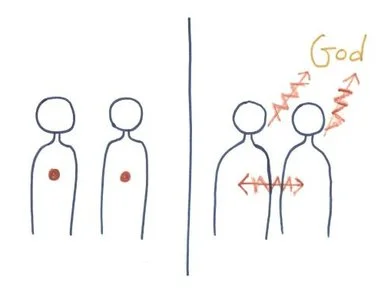
Sin as a relational problem — this view focuses on broken relationships as the root problem that causes us to sin. As illustrated on the right side of the above diagram, a lack of trust distorts our relationship with God, ourselves, others, and creation. Those twisted relationships lead us to commit actions that hurt God, damage ourselves, others, and creation. Humans are born into a web of distorted relationships that lead them to react in fear and mistrust. They are alienated and therefore they sin.

 Sin as an ontological problem — this view focuses on a state of being as the root problem. In an almost biological sense it sees humans as tainted or corrupt. Humans are at the core of their being bad or evil and therefore do evil. Humans are ontological sinners and therefore they sin. Or, as illustrated in the left side of the above diagram, people think of sin like an ugly cancer within our being that causes us to commit actions that hurt God, damage ourselves, others, and creation.

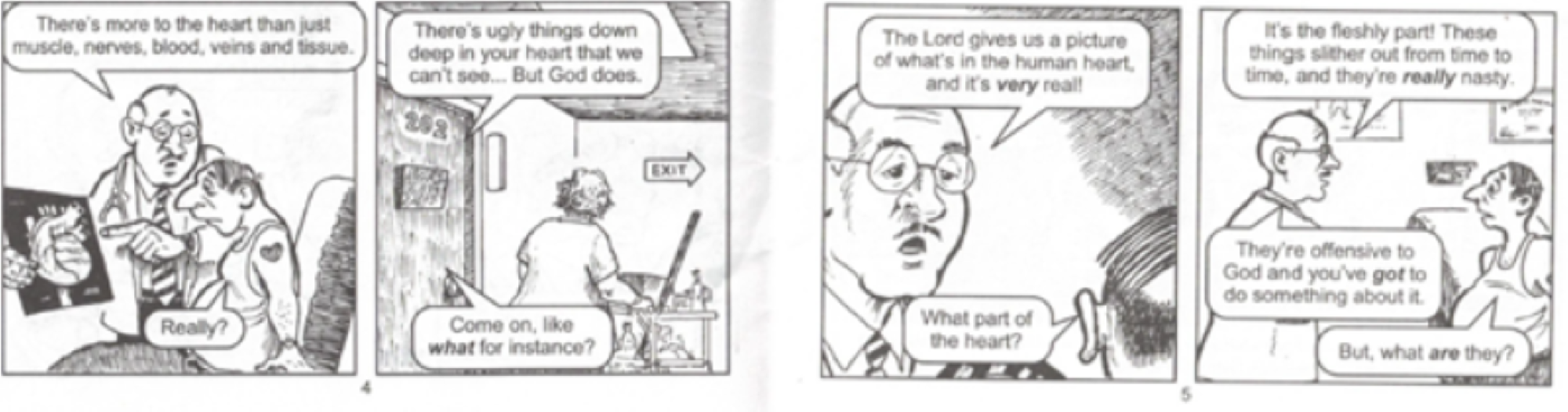
 I have qualified my language with the word “like”—"like an ugly cancer,” “biological-like” and “like a sin gene.” The reality, however, is that many Christians do think of sin as passed on from generation to generation in a very physical way—as seen in this tract’s portrayal of sin. On the previous page, the doctor had said “Everybody’s born with a bad heart problem.”

Sins sliver out of the fleshly part of the heart

Later in the tract, the doctor says, “When Adam and Eve disobeyed God, everything changed, especially our hearts, and that got passed down to us.” Note, a relational view of sin would affirm almost everything in that sentence, but would say “relationships” instead of heart. It could use “passed down” language, but might more clearly say something like, “and we have all been born into that web of alienated relationships.” (The tract is, Heart Trouble?, Chick Publications, www.chick.com)

 Although thinking of sin as part of our being in a physical sense is very common today, and seen by many as the orthodox view, it is not explicitly in the Bible, it was not used for the first 300 years of church history, and it was never adopted by the Eastern Orthodox churches.

 Many of us have tended to read biblical passages on sin from an ontological perspective and think that they clearly state that our being is in some way evil or sinful, and therefore we sin. I maintain that those passages can be understood in line with the above paragraph on the relational paradigm of sin. So, for instance, when Paul talked about his old self, he could be referring to a human who is fundamentally alienated from God, others, and self. We can still talk of being born in sin, or born as sinners, but I would choose to interpret that in a relational sense (see the "web" language above).

 Do we receive some gene or cancer that makes us sin, or do we receive from our parents and ancestors relational alienation? I maintain that at the root of sin is lack of trust or unbelief which is manifested in distorted relationships and which causes the actions we call sins.

 Bounded, Centered, and Our Concept of Sin

In class, after presenting the two concepts of sin I would ask, “what difference does this make in life? How will each concept lead people to think of themselves? How will your view of sin influence how you approach pastoral care, counseling, discipleship?” The ontological concept leads many people to think of themselves as unrepairable. From this perspective, a life of faith in Christ offers forgiveness for sinful acts caused by the sin gene and gives the hope of a body without the sin gene in heaven. In the meantime, the sin gene is present. If an individual, or church community, accepts that as reality, pastoral care and discipleship will likely be seen as sin-control—seeking to lessen the damage from a physically sinful heart.

 In contrast, if the fundamental problem is viewed as broken relationships, then salvation through Jesus is not limited just to forgiveness and a future hope. Healing of alienation starts in the moment of salvation and can continue in this life on earth. Rather than just trying to build a containment wall around the root problem, the relational view understands that we can lessen the severity of the root problem. Pastoral care and discipleship will not bring full healing this side of heaven, but can significantly lessen alienation. In contrast to the ontological view, a relational approach will focus not only on the sin actions flowing from the root, but on the root as well.

 I heard myself say something like that in the conversation with my daughter, and at that moment I noticed the similarity to the image and language of a bounded-set church. In many ways the bounded approach is about containment—sin control. The boundary wall is the key tool for behavioral change. In a centered-set church the key is relationship—relationship with the center and relationship with those who walk with us in becoming more Christlike. Therefore, an ontological view of sin will contribute toward a bounded church mentality and a relational view of sin will facilitate a centered approach. I want to be careful to not overstate. A church that teaches an ontological view of sin can still work at being centered—and benefit from doing so. Teaching a relational view of sin does not alone protect a church from being bounded or fuzzy. Rather, they both feel like compost. Adding an ontological view of sin to the soil of a church will enhance the sprouting and flourishing of a bounded-set church. Adding a relational view of sin to the soil of a church will enhance the sprouting and flourishing of a centered-set church.

 Therefore, recognizing that many people who have never heard the term “ontological sin” nor read a theology book have an ontological view of sin, let us in our preaching, counseling, spiritual direction, and teaching explicitly challenge the sin-gene concept and replace it with the relational understanding of sin.


Footnote #1

The ontological understanding of sin traces back to Augustine, and sadly, to a poor translation of one verse. John E. Toews wrote that Augustine “consistently taught that sin originated in the transgression of Adam and was transmitted from generation to generation through human reproduction” (85). Augustine rooted his understanding of all humans inheriting sin from Adam in a seminal manner in Romans 5:12—a text he cites more than 150 times. Unfortunately, Augustine did not know Greek well and he relied on a Latin version that mistranslated the verse.

Instead of an accurate translation like:
“Therefore, just as sin entered the world through one man, and death through sin, and in this way death came to all people, because all sinned—”

 The version Augustine read said,
“Therefore, just as sin entered the world through one man, and death through sin, and in this way death came to all people, in whom all sinned—"

That “in whom all sinned” supported his idea that a piece of the soul was contaminated and passed through male semen.

Toews’s short book, The Story of Original Sin, provides not only a chapter detailing Augustine’s missteps, but more importantly displays how up until that time, both Jews and Christians, did not hold an ontological view of sin.

 Footnote #2

When I presented this material in class, some students would argue for a combination of the two views. I always argued against that—seeing it as an effort to hang on to something I thought better to let go of. But about five years ago a student, Susan Tovar, argued for a combined view that led me to acknowledge that reality is more complex than my two neat categories. There can be a physically inherited aspect to sin. She said that recent studies in epigenetics point to traumas of ancestors, their fears and anxieties, being passed on genetically. These researchers would respond to what I have written by saying we not only are born into webs of broken relationships, but we are born with inherited trauma. We might say some woundedness is passed on ontologically.

 After our Zoom class (during COVID) I sent Susan a note asking her to help me understand better what she had said and to think with me about the difference between this sort of genetical inheritance and the ontological view of sin seen in the tract. Our conclusion was that it was correct to still say that original sin, the root problem, is relational. We also discerned that whereas the ontological view sees the sin presence in the being as permanent and unchanging, people can experience healing from inherited trauma. Genetically inherited trauma can be changed.

Posted on January 8, 2026 and filed under Centered-set church.