
Three weeks ago, I my wife and daughter ate lunch with a group sitting around two tables—like ones you would find at most churches. But the conversation differed from any church meal I had been at. “Jose” had just told us that even though they live in the same neighborhood, because of gangs, he could visit “Keli’s” and “David’s” houses, but he could not visit “Tania’s or “Sara’s.” Their friendship and joy to be together around these tables in neutral territory was evident, yet he had never been to, nor could he go to, Sara’s or Tania’s homes. Two gangs control different parts of the neighborhood. People who live there can’t cross the lines.
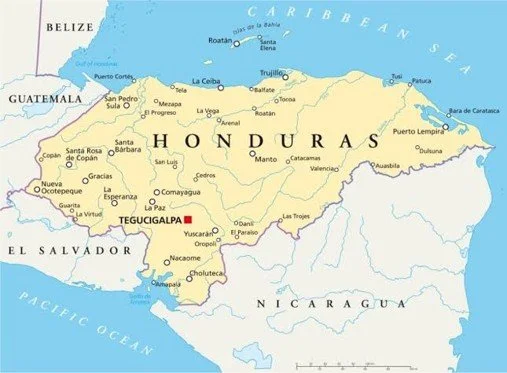
This church, Iglesia en Transformación, is in Tegucigalpa, the capital of Honduras. After years of meeting in schools, the church of young professionals bought a slice of land between a private university and Los Pinos, a poor neighborhood. To their credit, they have worked to include those represented by both their neighbors. Our small non-profit, Vida en Shalom, helps fund the church’s thriving ministry to children of Los Pinos. Currently 100 children participate in an after-school program that includes a meal, tutoring, music classes, Bible stories, health care, and more. During lunch, Liliam, the president of the church council, introduced us to seven young adults who serve in the program—three of them paid, the others volunteer. Five of them live in Los Pinos and were in the program themselves as children.
Earlier, Liliam had pointed out David to us and told us that when he was a boy, rather than walking directly to school he had to take a circuitous route because of gang -erritory dynamics. Curious about how a young child lived with realities like that, at lunch I asked David, “Can you tell us about your walk to school as a child.” He simply said, “It took about half-an-hour.” I pressed for more. “Did you have to walk further because of gangs?” He simply said, “about twenty minutes.” I had wanted to explore what seemed quite significant to me, and apparently to Liliam as well; David’s no-big-deal answer disappointed me. (In retrospect, I realize I missed that actually David did tell me a lot with his simple answer. He communicated that as a child in Los Pinos it felt quite normal to go out of the way to never walk in certain parts of the neighborhood.)
Jose, perhaps sensing I desired to know and understand more than I was getting from David, jumped into the conversation. His comment about whose homes he could visit and those he could not instantly changed my perspective of those sitting around me—and how different their lives were from mine. Seeing my surprise at Jose’s statement, one of them explained that the gangs constantly watch who comes and goes, who lives in their territory and who does not. Another shared that as a child her parents had told her where she could not go. They said, “bad people are there; they will kill you.”
Seeing my interest, Jose continued. He said, “The gangs look for kids from dysfunctional families who would be attracted to joining a gang ‘family.’ Therefore, the church’s program seeks to give children a place they feel a sense of belonging.”
Thinking of my friend Bob Brenneman’s research, I wanted to press deeper and hear their observations about the role of shame in people joining gangs. But, I also wanted hear about their involvement in the church’s program. I said, “Rather, than talking about why kids join gangs, let’s head in a different direction. Why are you here, serving in this program?”
Sara said, “I am here because of how people in the program treated me when I was a child. They were so good to me. I didn’t want to leave. They never yelled at me.” Reflecting more generally, she said, “Poverty in Los Pinos is multidimensional—including limited water. Some children take showers and wash their clothes at the church. We try to address the various dimensions of poverty.” David said, “It is my second home. I have come since I was four.” Keli said, “It was a second home for me too. I have come since I was seven. I am here now because I want to do for children what others did for me.” Kenia said “I started coming when I was 8. At first, we escaped from our house to come. Our mother punished us for leaving, but eventually she gave us permission. I come now to give back what I have received.” Jose said, “I felt supported and loved, not only as a child, but also they helped me be able to go to high school and now the university. I volunteer as a way of saying thanks.”
My wife Lynn turned to me and our daughter Julia and said, “Love breeds love. Hate breeds hate. Love is contagious.”
Recent news from Los Pinos: I sent this blog to Liliam to confirm details before posting it. She shared the sad news that “Tania’s” 29-year-old brother was murdered last week. Here is a translation of a few lines from Liliam’s e-mail. “ . . . he had also participated in our program as a child and is now another victim of the growing violence that the young people described during our lunch together. The strongest suspicion is that he was murdered to steal his motorcycle.
We ask for your prayers for Tania, her family, and the ministry team, who, like our children and youth, remain immersed in this sad reality. We are challenged to continue proclaiming the faith and hope of the Kingdom of God.”